
Foreign and Strange (in the Land of Egypt)
Martine Schwan
At the pesach seder, the Rabbi asks us to explain, one by one, how we personally see ourselves, in this moment or perhaps more generally, as having left Egypt. A contemplative silence descends over the room. Salt water sloshes around in plastic dining hall cups perched on the rickety, U-shaped table. I’ve dragged a couple of my best goys along with me for the occasion — my first Passover in three years — and their eyes bug out, not expecting such a question. Mine do too — I wasn’t either. But it’s my turn before I know it. The shank bone, sprawled audaciously over one of the silver seder plates studding the tablecloth, points straight at me. I say that my name is Martine (she/her, junior) and that I see myself as, uh, being liberated from Egypt by fighting for people who are oppressed today. That, in reality, none of us have left Egypt until all of us have. A chorus of nods all around the room. I look down into my hands, into my overly-formal skirt that I wore because it's been so long and I don’t know how to dress for organized religion anymore.
It is hard to imagine Judaism without the story of Passover. Yet there is no historical evidence supporting the Israelistes’ enslavement in Egypt, nor their great Exodus. For most Jews, the story functions instead as a part of our cultural mythos; it means something because of what it has meant to those that came before. When we take turns reading from the haggadah, the resonance of the words, not their accuracy, is the point. What, then, does it really mean for Jewish college student in America to see herself as having left Egypt? As the question travels around the room, we become practitioners of myth, arranging our words and bodies around a memory that is neither ours nor, perhaps, our ancestors.’ We close our eyes and ball our fists and will ourselves there, to the Red Sea raging, our necks craning to watch Moses split it in two.
The girl two people down from me is piggybacking off my response; she gestures in my direction to demonstrate this. Her hands, lithe and sure, implicate me in her answer, and I’m suddenly self-conscious. I flip open my haggadah, hoping to take refuge in its familiar pages. To my horror, I feel my eyes lingering on the transliteration instead of the Hebrew I spent ten years learning one time long ago. I shut the book, whisper to my friend to pace herself with the wine during the seder because there are four cups of it — that much I can remember.
Passover is a favorite holiday among Jewish activists, which I surmise to be at least partially because of Exodus 22:20. This line of Torah, one of the most frequently quoted in the Reform Jewish communities in which I came of age, reads: “You shall not mistreat a stranger, nor shall you oppress him, for you were strangers in the land of Egypt.” Interestingly, some translations substitute “stranger” for “foreigner” or “alien,” a recognition of the fact that the Israelites were a foreign people in Egypt, having migrated there from Canaan around 1500 BCE — the lesser-known of the Passover Exoduses.
Linguistically, the border between the stranger and the foreigner is porous. The Hebrew גֵּר refers to both, as does the French étranger, a source of puzzlement for me back in middle school when the French language still felt like a secret code. It is a jarring sensation at first to say a word and unwittingly summon the ghost of its second meaning, delayed but potent, like an aftertaste. But by the time I arrived in Paris eight years later for my semester abroad, my lips and tongue had grown accustomed to forming this word in its different contexts. One November weekend, my friends and I escaped the constricting tautness of Paris’ twenty coiled arrondissements for the lakes and hills of Lausanne, Switzerland. We lugged our bodies up and down the city’s grueling topography and peered into store windows, marveling at how expensive everything was. At the top of a particularly steep hill, we sighted a black cat slinking through the gate of a large house. Huffing and puffing, we dropped to our knees to caress its soft fur. Its owner appeared seconds later, and, noticing the way we rushed to cobble together clauses and conjugations when he spoke to us in French, inquired about our nationality. We soon learned that he had taught playwriting at Harvard back in the day, and when a couple of us shared that we were from Boston, he became visibly more comfortable. As he spoke, the already near-deserted streets seemed to empty completely, making space for his singular, rasping voice. One of the reasons Switzerland is so prosperous, he told us, his words inflected with more than a touch of pride, is because of the regulations placed on étrangers. When he bent down to scratch his cat behind the ears, my friends and I eyed one another. We had been learning French long enough to know which étranger he meant.
As I sip from my first cup of wine, I realize that this is the first time I’ve been in a room of mostly other Jews in years. I’m hoping they can’t tell I'm groping for undertones in their words, blindly and desperately, like a hand feeling around for a hard-earned bag of chips at the bottom of a vending machine. Searching for slight leanings, hard stances, reactions to the videos I’ve seen, the things I’ve read. The violence, the dissolution, the pleas for recognition of what is palpable and yet unimaginable. The girl who is now speaking — Did she go on birthright? — twirls a dark curl in her fingers. She looks like me.
Exodus 22:20 is so inescapable in Jewish activist spaces that I hardly bat an eye when I saw it being used on social media to promote empathy for Gazans in 2023. I am sure that I reposted the call for solidarity without a thought. Revisiting the phrase now, though, I get stuck on the word “stranger” and the foreignness I know to be haunting it. The implication, while partially masked by the chosen translation, is that there is something foreign about a Palestinian subject. To be sure, for a mind closed off by Zionist ideology, a real Palestinian person, in all their effervescent humanness, is indeed a foreign subject, coming into view only when one dares to make like Isabella Hammad and recognize the stranger. But there is something sinister about the implication that Palestinians are strangers to their land, no different from the Israelites in the land of Egypt.
Yisrael, the Rabbi tells us between prayers and ritual hand washings, does not refer to the State of Israel as we know it today, but rather is symbolic — an abstract idea of a Jewish utopia. He swirls a sprig of parsley in salt water then plucks it out, letting it shed a few tears before popping it in his mouth. The people around me are nodding, assuaged. I am nodding. I imagine this Yisrael for a second — rootless, dreamlike, seed-like. An idea, germinating.
Ramesses II, the Egyptian pharaoh mythically commanded by Moses to let his people go, is believed to have had up to a hundred children. His thirteenth son, Merneptah, became pharaoh after his father and is estimated to have reigned from 1213-1203 BCE, near the end of the Israelites’ 250 years of strangerhood in Egypt. The Merneptah Stele, a ten-foot granite slab residing in the Egyptian Museum in Cairo, is engraved from top to bottom with some of his military campaigns. Among the lines upon lines of hieroglyphics is the first mention of Israel in recorded history:
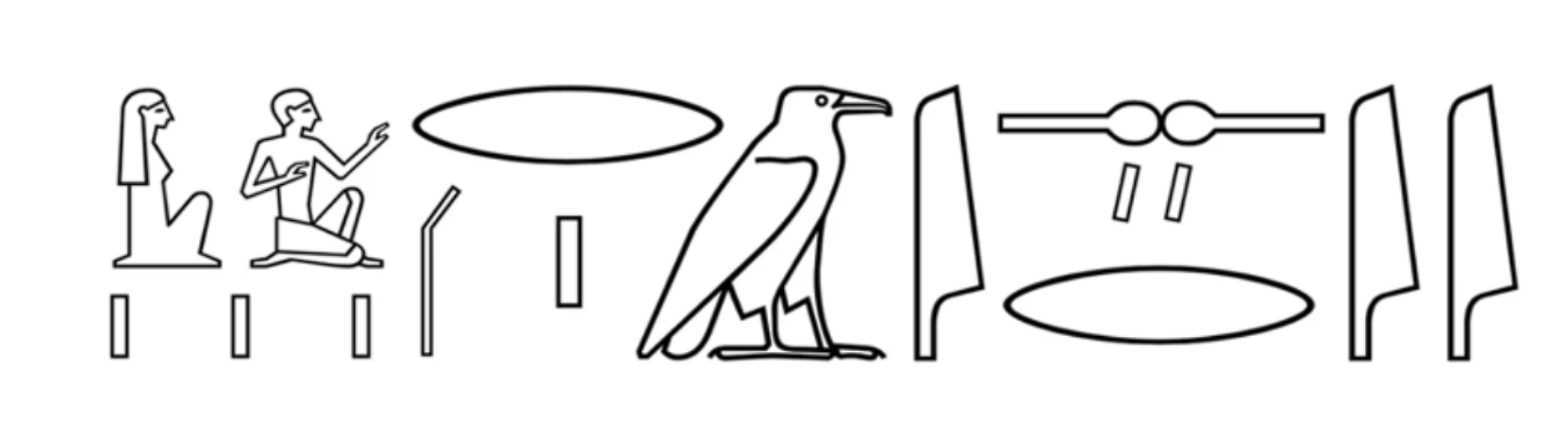
Translators have determined that the seated man and woman on the left side of the glyph denote a group of people. Thus, while the Merneptah Stele references many nations and cities, the “Israel” carved into the granite is a stateless one, a people-group, possibly nomadic.
Growing up, the Israel I knew was anything but stateless. Israel was the blue and white flag perpetually displayed on the bimah, the 2-in-1 tech hub/verdant oasis trapped between countries hungering for its destruction. Israel was the unbeatable military power that required our donations so as not to be beaten. It was kibbutzim and olive trees, the incomparable feeling of floating weightlessly in the Dead Sea, the ten-day trip that would change our lives forever.
I became acquainted with Israel’s cousin Yisrael in prayer. “What’s with all this Yisrael stuff anyway?” I would wonder aloud on the car ride home after Friday night services, knowing that this always made my parents laugh. But I wondered quietly, too. What was it about these syllables, these vibrations arcing through the air to my ear, that was so inseparable from Jewishness — from my Jewishness? Now, as a college student, I continue to wonder, sometimes quietly and sometimes loudly: Is there safety in abstraction? Or, to be concrete: What is the line between a Jewish utopia and an ethnostate?
The Hebrew verb פָּסַח — pasakh — is generally understood to mean “to spare,” “to pass over.” Of course, on Passover (get it?), it describes the trajectory of God, who, in noticing the smears of lamb's blood on the door frames of the Israelites in Egypt, famously spared them from makkat bechorot — the slaying of the firstborn son. This is the פָּסַח I grew up with. Lurking behind this hulking meaning, however, is a gentler one, overshadowed but not eclipsed. Instead of pasakh: to spare, we have pasakh: to hover. Various scholars of Torah have pointed out that this meaning of פָּסַח, in context, carries a sense of protection. Some of them imagine God as a bird, engulfing the houses of the Israelites in its winged embrace. I prefer to visualize the embrace of my Bat Mitzvah tallit, spread protectively across my back and shoulders as I graduated to Jewish adulthood. The words of my childhood Rabbi in my ears: May God bless you and keep you. In light of this second meaning, the classic Passover image changes, subtly but importantly. The Israelites are not merely “spared” but “protected,” chosen as the targets of God’s conditional love. The plague prods at their doors and windows but cannot enter, finding the defenseless bones of Egyptian firstborns to prod at instead. Implicit in every “chosen people” is a people that is fatally not chosen. The feathers of the bird — the tassels of my tallit — are soft at the edges, but they vibrate with the specter of mass genocide.
At the pesach seder, there are stories to tell and Hillel sandwiches to make, and I do not think about feathers or tassels. We are about to recite the Kiddush for the second time now, and I fill my friends’ cups up with Manischewitz. Second of four, I remind them, laughing, wondering a little about Yisrael and Israel and whether there are millennia or worlds between them or perhaps nothing at all.
MARTINE SCHWAN is a senior at Vassar College, where she studies English and French and serves on the executive board of Conspiritu, Vassar’s student-run literary and art magazine. Her writing weaves many threads but is often preoccupied with science, identity, the body, and language. She can be found on Instagram @martine_ilana.